
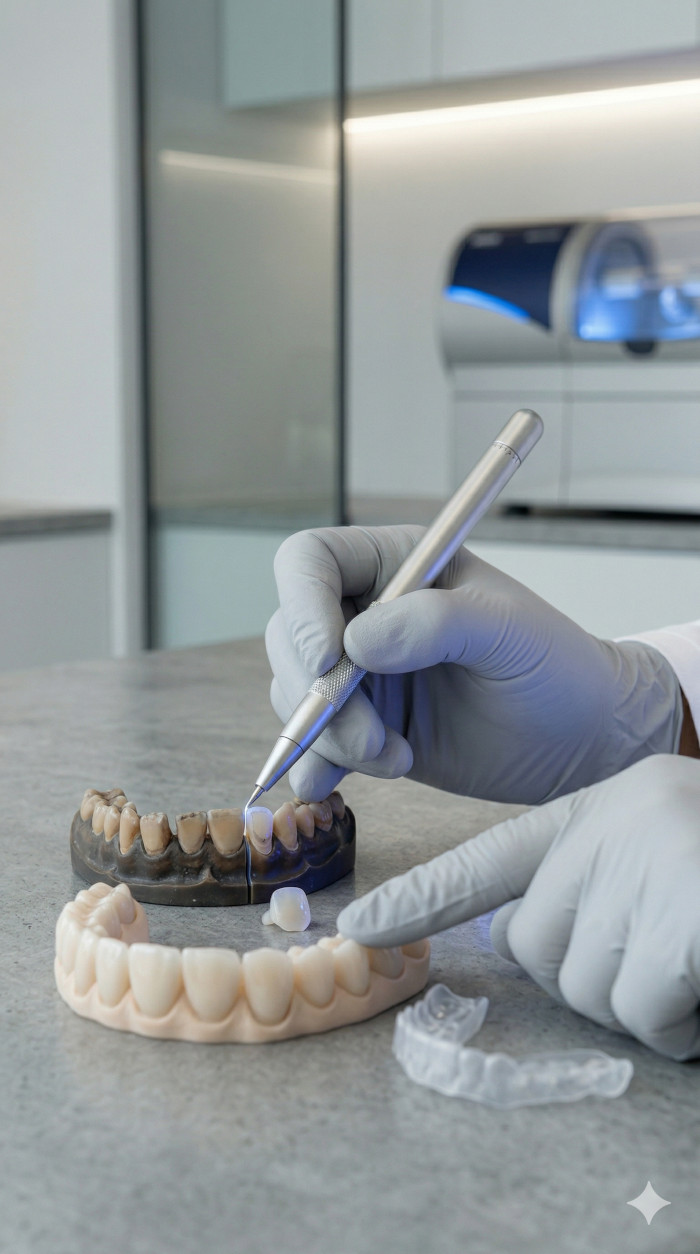


As a dentist, I spend a lot of time looking at mouths, obviously. But I also spend a lot of time looking at people. Listening to them. Understanding what brought them into the surgery on a rainy Tuesday morning. Very often, it isn’t pain. It’s a slow, creeping realisation that their smile just doesn’t look like them anymore.
Teeth work incredibly hard. Think about what we put them through over a lifetime. The morning coffees, the wine, the years of clenching your jaw through a difficult period at work. Slowly, over the years, the enamel begins to thin. The edges begin to chip. The colour shifts from a bright, reflective white to a duller, warmer yellow or grey. People usually come in with a very specific request. They sit in the chair and point to a single front tooth and say they want it fixed. Or they ask for the strongest whitening gel we have because they think that will solve everything. It’s completely understandable. We’re conditioned to look for a single, straightforward fix.
But mouths don’t really work like that. Your teeth are a neighbourhood. They sit together, they function together, and visually, they rely on each other. If you have a street where all the houses look a bit tired, painting just the front door of one house doesn’t make the street look better. It actually just highlights how tired the rest of the street is. This is where the artistry of what we do really comes into play. Fixing a smile is rarely about one single procedure. It’s about understanding how different treatments work together to create something that looks entirely natural. It’s a bespoke service. We look at the wear, the tear, and the discolouration, and we build a plan that addresses the whole picture.
So let me walk you through how we actually build a plan. It usually starts with colour.
The foundation of almost any aesthetic work we do usually starts with the colour. Whitening is the blank canvas. Over time, the microscopic pores in our enamel absorb stains. Even if you have the most meticulous brushing routine in the world, life leaves its mark. The underlying dentine, which is naturally yellower, also thickens as we age, while the outer enamel thins, letting that yellow hue show through more clearly.
When we set out to fix worn teeth, we almost always start by lifting that baseline colour. Why? Because any restorative work we do, whether that’s bonding or a veneer, is colour-matched to the exact shade of your teeth on the day we place it. Restorative materials don’t change colour. If we match a beautiful new edge to a yellowed tooth, and then you decide a year later that you want to whiten your teeth, your natural teeth will brighten, but that restorative work will stay exactly the same. You’d be left with a patchwork effect.
So, we whiten first. We use gentle, professional gels in custom-made trays that fit your mouth perfectly. This isn’t about blasting your teeth with harsh chemicals. It’s a controlled, gradual lifting of the shade. You do it at home, over a few weeks, until we reach a shade that looks bright, healthy, and entirely natural for your skin tone and age.
Once we have that beautiful, bright canvas, we can start looking at the structure. This is where the magic really happens.
Imagine a beautiful old photograph that’s been folded and kept in a wallet. The image is still there, but the edges are frayed. That’s what wear and tear does to your teeth. The most common solution we use to repair this is composite bonding.
Bonding is an absolute joy to do. It’s essentially freehand sculpting. We use a high-grade, tooth-coloured resin. It’s a material that handles a bit like clay before it’s set. We carefully apply it to the worn edges of your teeth, shaping it, smoothing it, and blending it seamlessly into your natural enamel. Then we use a special blue light to harden it instantly.
The beauty of combining whitening with bonding is the harmony it creates. We match the resin perfectly to your newly brightened teeth. If your teeth have flattened out from years of grinding, we can use bonding to rebuild those natural, youthful curves. We can close small gaps. We can repair little chips.
Because bonding is added to the tooth, it’s highly conservative. We rarely need to drill away any of your healthy tooth structure. We’re simply replacing what time and friction have taken away. The result is a smile that looks incredibly fresh but still entirely yours. The whitened teeth provide the youthful brightness, and the bonding restores the crisp, clean edges.
However, bonding has its limits. It’s fantastic for mild to moderate wear, but resin isn’t as strong as natural enamel. If you’re a heavy tooth grinder, or if the wear is very extensive, bonding might chip or stain over time. It requires a bit of maintenance. You have to treat bonded teeth with a bit of respect. No using them to open packets of crisps or bite your nails.
When the wear is more significant, bonding alone won’t do the job.
Veneers sometimes get a bad reputation. Again, people think of the extreme examples. But beautiful, handmade porcelain veneers are the pinnacle of restorative dentistry. They are wafer-thin shells of ceramic that are custom-made by a highly skilled dental technician to fit over the front surface of your teeth.
Porcelain is an incredible material. It mimics the way natural enamel handles light. Natural teeth aren’t flat, opaque white blocks. They’re slightly translucent, especially at the edges. Light enters the enamel, bounces off the underlying dentine, and gives the tooth a lifelike vitality. High-quality porcelain does exactly the same thing.
Combining whitening with veneers is a very common and highly effective approach. We often see patients who have heavily worn, short, or damaged upper teeth, but their lower teeth are relatively healthy, just a bit discoloured.
In a case like this, applying veneers to every single tooth would be unnecessary and overly invasive. Instead, we take that bespoke approach. We might suggest whitening all the teeth first to lift the colour of those healthy lower teeth to a beautiful, bright shade. Then, we meticulously design and place porcelain veneers on the upper teeth, colour-matching the porcelain to blend perfectly with the newly whitened lower teeth. This creates a seamless, natural look while preserving as much of your healthy tooth structure as possible. It’s a puzzle, and every piece has to fit together perfectly. The whitening takes care of the global discolouration, while the veneers do the heavy lifting of restoring length, strength, and perfect shape to the damaged areas.
Sometimes, we even use all three. A combination of whitening, bonding, and veneers.
Think of a patient who has a couple of heavily filled, dark, damaged front teeth, but the teeth next to them are perfectly healthy, just a little worn at the tips. We wouldn’t want to cut down those healthy teeth for veneers just to make them match. So, we’d whiten everything first. Then, we might place two beautiful porcelain veneers on the damaged front teeth to give them back their strength and perfect form. Finally, we might use a little bit of composite bonding on the adjacent healthy teeth just to crisp up those worn edges and bring the whole smile into perfect harmony.
This mixed approach is really the hallmark of modern, patient-centred dentistry. It requires planning, a good eye for detail, and a deep understanding of the materials we’re using. But the results are incredibly rewarding.
We spend a lot of time in the planning phase before we even touch a tooth. We take photographs, sometimes videos. We make models of your teeth and sometimes do a mock-up. This involves placing some temporary material over your teeth so you can actually see what the final result might look like in your own mouth, before you commit to anything. It’s so important that you’re part of this process. It’s your face, after all. We sit down together, look at the photographs, and talk about what you like and what you don’t like. We discuss the shapes of the teeth. Do you want them slightly more rounded for a softer look, or slightly squarer for a bolder look? We talk about the exact shade of white.
It’s never a rushed conversation. A true bespoke service takes time. It takes listening.
I often see the physical transformation in the chair, which is wonderful. But the real joy is seeing the emotional transformation. It happens gradually over the course of the treatment.
When someone first comes in, they might be guarded. They might speak without fully parting their lips. They might apologise for the state of their mouth. It happens all the time, and I always tell them there’s no need to apologise. Life happens to all of us.
As we progress through the plan, perhaps after the whitening is finished, you start to see a shift. They come in for their next appointment and they’re sitting a little taller. They might be wearing a brighter shade of lipstick, or they just look a bit more rested. Then comes the day we finish the bonding or place the veneers. We hand them the mirror. That moment is always special. Sometimes there are tears, sometimes just a very wide, quiet smile. But the biggest difference is how they leave the surgery. They walk out differently. They engage with the reception team differently. The self-consciousness is just gone. They’re not thinking about it anymore.
It’s worth understanding what’s actually happening to the tooth, because it changes how you think about fixing it. Our teeth are incredibly strong. Enamel is the hardest substance in the human body. Yet, it isn’t invincible.
When we chew, there’s an immense amount of pressure exerted on the biting surfaces. Over decades, this constant friction naturally smooths away the little ridges and textures we’re born with. Then you add in the environmental factors. The modern diet is highly acidic. Sparkling water, fruit juices, and even healthy things like salad dressings can temporarily soften the enamel. If you brush your teeth too vigorously right after eating something acidic, you’re essentially brushing away microscopic layers of that softened enamel.
Then there’s bruxism, which is the medical term for teeth grinding. It’s incredibly common. Many people do it in their sleep without ever realising it. The jaw muscles are incredibly powerful, and when they grind the upper and lower teeth together night after night, the resulting damage can be quite severe. The teeth begin to look flat, short, and sometimes quite sharp at the edges where the enamel has chipped away.
This loss of structure doesn’t just affect the appearance of your teeth. It can change the whole architecture of your lower face. As the teeth get shorter, the distance between your nose and your chin decreases when your mouth is closed. This can lead to deep creases at the corners of your mouth and a slightly sunken appearance. So, when we talk about using a bespoke plan to fix worn teeth, we’re often doing more than just making them look pretty. We’re restoring the lost vertical height of the face. We’re providing support for the lips and cheeks. It’s a functional restoration as much as an aesthetic one.
This is why a single veneer or a quick fix is rarely the answer for significant wear. If we just stick a piece of porcelain on a front tooth without addressing the grinding or the overall bite, that new veneer is going to be subjected to the exact same destructive forces that wore down the natural tooth. It’ll likely chip or pop off entirely.
Our comprehensive approach involves carefully analysing how your teeth come together. We look at your bite, your jaw movements, and the pathways your teeth follow when you chew or speak. Sometimes, before we even start the cosmetic elements, we might need to build up the back teeth slightly to create a stable foundation and take the pressure off the front teeth.
It’s a deeply considered process. The whitening, the bonding, and the veneers are just the tools we use. The real skill is in the blueprint.
We often find that people hold onto misconceptions about cosmetic dentistry based on what they saw twenty years ago. The materials and techniques have advanced remarkably.
Take bonding, for instance. In the past, the resins available were quite opaque. They looked a bit flat and plasticky. Modern composite resins are beautiful. They come in a vast array of shades, not just of white, but of translucency. A natural tooth isn’t one solid colour. It’s slightly darker near the gum line, brighter in the middle, and slightly clear at the biting edge. When we do a composite build-up to repair wear, we actually layer different types of resin to mimic this natural anatomy. We might put a warmer, more opaque layer underneath to mimic the dentine, and then a highly polished, translucent layer over the top to mimic the enamel.
It requires a very steady hand and a lot of patience. It’s painting with light and shadow, using dental materials instead of oils or watercolours. The goal is always that nobody, not even another dentist sitting across a dinner table, would immediately spot the work. They should just see a healthy, vibrant smile. The same evolution has happened with porcelain. The ceramics we use now are incredibly strong but can be milled or pressed to be almost impossibly thin. This means we don’t have to aggressively file down your natural teeth to make room for them. In many cases, we barely need to touch the natural tooth structure at all. We just lightly prepare the surface so the veneer can bond to it with immense strength.
The combination of these advanced materials with a carefully planned aesthetic vision allows us to do things that simply weren’t possible a generation ago. We can offer a plan that isn’t just a quick aesthetic fix, but a long-lasting, structural restoration that harmonises perfectly with your face.
I remember a gentleman who came to the surgery last year. He’d spent his entire career in a high-stress corporate environment and his teeth showed it. They were very flat, quite dark, and the edges were jagged. He was retiring and wanted to do something for himself. He told me he felt his smile made him look tired and angry, even when he felt perfectly fine.
We didn’t rush in with a drill. We spent weeks planning. We started with a very gentle, prolonged course of whitening. Because his teeth were quite dark and the dentine was thick, we took our time to ensure we lifted the colour evenly without causing sensitivity.
Once we had a brighter base, we realised that we needed to restore the length he’d lost to grinding. We used porcelain veneers on his upper front teeth to give him back his natural tooth length and provide support for his upper lip. But his lower teeth, while worn, didn’t need the structural support of porcelain. So, we meticulously applied composite bonding to the edges of his lower teeth, perfectly matching the shade to his new veneers.
The transformation was remarkable. It wasn’t just the teeth. The restored length softened the creases around his mouth. The brighter colour illuminated his whole face. He looked ten years younger, but more importantly, he looked relaxed. He looked like himself again.
That is the power of combining treatments thoughtfully. It’s never a one-size-fits-all approach. It requires patience from us, and trust from you.
We understand that discussing your teeth can feel very personal and sometimes a bit vulnerable. Many people carry a lot of dental baggage. Perhaps they had a bad experience as a child, or perhaps they’ve just felt embarrassed about their smile for so long that talking about it feels uncomfortable.
Please believe me when I say we’ve seen it all. There’s absolutely no judgement here. We’re solely focused on the future and how we can help you achieve the smile you want. The initial consultation is just a conversation. We’ll look at your teeth, take some photographs, and chat about your goals. If you decide you want to go away and think about it for six months, that’s entirely fine. There’s no pressure. We’ll outline the options clearly. We’ll explain exactly how whitening might work for you, where bonding could be beneficial, and whether veneers are something to consider. We’ll map out the timeline and the costs transparently.
You don’t have to know exactly what you need when you walk through the door. You don’t need to know the difference between composite resin and porcelain. That’s our job. All you need to know is how you feel about your smile right now, and how you’d like to feel.
Maybe you’ve noticed your teeth look a bit shorter than they used to in old photographs. Maybe the colour has deepened and over-the-counter toothpastes just aren’t making a difference anymore. Maybe you have a slight chip that your tongue keeps finding.
Whatever it is, it’s usually worth having a chat about it. We can look at the whole picture together. We can explore how a combination of treatments could work for you. It might be simpler than you think. It might just be a gentle course of whitening followed by an hour of bonding to soften the edges. Or it might be a more comprehensive plan to completely rejuvenate a smile that has worked very hard for you over the decades. There’s no single correct way to do this. There is only the way that’s right for you, your teeth, and your lifestyle. We take immense pride in figuring out exactly what that is, and then delivering it with care and precision.
Drop us a line or give the reception team a ring whenever you feel ready for a cup of tea and a chat about what’s possible for your smile.