
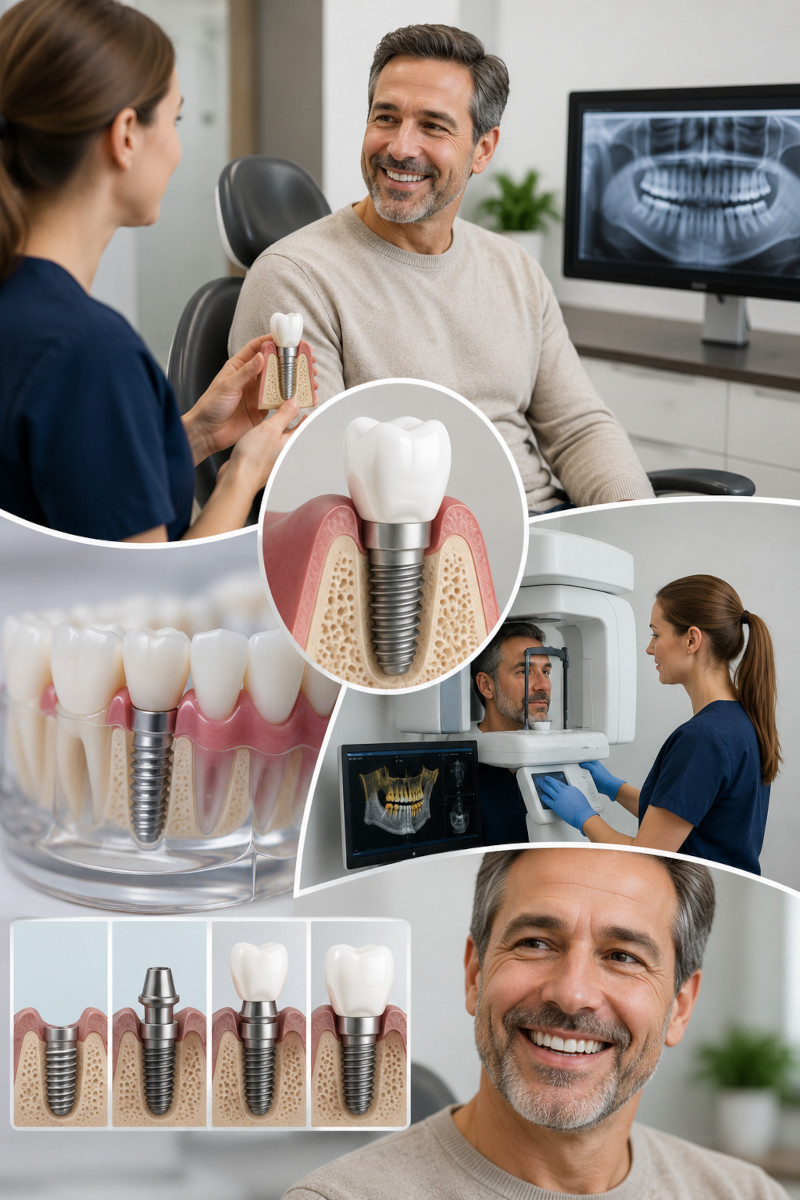


What a dental implant actually is
A missing tooth changes small things first. You start chewing on the other side, ordering the soup instead of the steak, smiling with your lips together in photographs. An implant is designed to give those small things back.
Technically, it is a titanium post placed in the jaw where the old root used to be. Titanium has a useful talent: bone treats it as one of its own and fuses to it, a process called osseointegration. Once that fusion is complete, the post works like a natural tooth root and can support a porcelain crown for a single missing tooth, or a bridge where several neighbouring teeth are missing. Nothing rests on the gum and nothing clips onto other teeth. It is the closest dentistry currently gets to growing you a new tooth.
Am I suitable for an implant?
The honest answer: most people are, and many of the rest can become suitable. The deciding factor is bone. An implant needs enough healthy jawbone to fuse to, and bone slowly shrinks in a spot where a tooth has been missing for a while. At your consultation we examine your mouth and take X-rays and scans to measure exactly what is there and plan the best position for the implant.
If bone has been lost, that is rarely the end of the conversation. A bone graft can encourage the tissue to replenish, rebuilding enough structure to hold an implant securely. Gum health matters just as much. Where gum disease has taken hold, we treat that first, because an implant depends on the same healthy foundations as a natural tooth.
The treatment, step by step
Implant treatment is a series of short chapters rather than one long day.
- The consultation. We examine your teeth, take X-rays and scans, check your bone density and plan precisely where the implant should sit. We talk through the treatment plan in detail, and you get the chance to ask every question you have brought with you.
- The placement. With you comfortable, relaxed and the area fully numbed, the titanium post is surgically placed into the jawbone. A temporary crown or bridge protects the site while it heals, so you are never left with a visible gap.
- The quiet months. The implant now fuses with your bone. This healing takes a few months, and it is the stage that gives implants their remarkable strength. There is nothing dramatic for you to do here except heal, eat carefully and keep the area clean.
- The fitting. Once the implant is solid, we take impressions so your permanent crown or bridge can be created from tooth-coloured porcelain. It is then fixed into place with a strong dental adhesive and colour matched to its neighbours. Most people struggle to spot which tooth took the scenic route.
How long do dental implants last?
With good care, decades. The porcelain tooth itself is resistant to bacteria, but the gum tissue and bone supporting it are not, so an implant lasts as long as its foundations stay healthy. That means brushing it like a natural tooth, cleaning between teeth, and keeping up regular check-ups and hygiene appointments with us. Patients sometimes assume an artificial tooth needs less attention than a real one. In truth it needs exactly the same, and it repays the effort for far longer. Looked after properly, an implant can last just as long as your natural teeth.
Implants compared with bridges and dentures
We fit bridges and dentures at Oriel Villas too, and for some patients they are the right choice. A conventional bridge is quicker but leans on the neighbouring teeth for support. A denture is usually the most affordable route, but it rests on the gum and comes out at night. An implant is the only option that replaces the root as well as the tooth, which is why it is the one that protects the jawbone underneath, and why it feels the most like the tooth you lost. The consultation is where we weigh all three against your mouth, your budget and your timescale, without pushing you towards any of them.
Frequently asked questions
Does having an implant placed hurt?
How long does the whole process take?
How much do dental implants cost in Cheltenham?
Written by Dr Jakub Wojcicki,
Dentist at Oriel Villas Dental Surgery
(GDC No. 84982)