
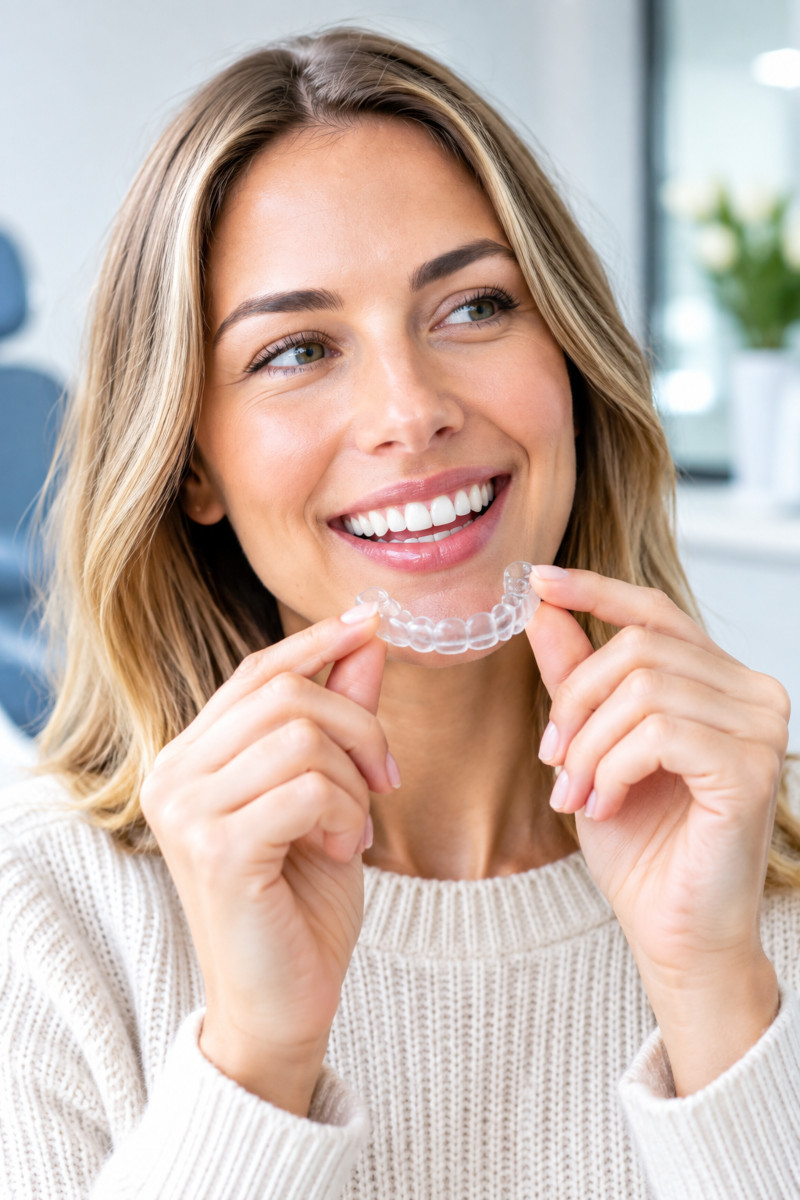


That scan is where Invisalign at Oriel Villas Dental Surgery begins, and this guide covers everything that follows it: what the aligners are, how treatment runs in our Cheltenham practice, how long it takes, who it suits, what it costs and what happens once the last aligner comes out.
What Invisalign actually is
Invisalign is a series of clear, removable aligners made from a thin medical grade plastic. Each one is shaped a fraction differently from the last, and each is worn for a week or two before you move on to the next in the box. The teeth follow the plastic. Over a course of treatment, thirty or forty small nudges add up to a straight smile, without a bracket or wire in sight.
Two things surprise people. The first is that the aligners are not entirely passive: most patients have small tooth coloured bumps of composite bonded to a few teeth, called attachments, which give the plastic something to push against. They are barely visible, but they are there, and they come off at the end. The second is that the aligners come out. You take them out to eat, to drink anything except water and to brush. That freedom is the whole appeal, and it is also the catch, because they only work while they are in.
How treatment works at Oriel Villas
It starts with an orthodontic consultation. We check the health of the teeth and gums first, because nothing gets straightened over untreated decay or inflamed gums, and then take digital scans and photographs with our iTero scanner. That is the point at which you see the predicted result on screen, before anything is made and before you have committed to anything.
If you go ahead, the scans go off to have your aligners manufactured, and a few weeks later you come back for a fitting. We check the first set sits properly, bond any attachments, and talk through the timeline and the wearing routine. After that you see us roughly every six to eight weeks so we can check the teeth are tracking with the plan and hand over the next batch. Near the end, some patients need a short set of refinement aligners to finish a stubborn tooth. Then come retainers, which we will get to, because they matter more than most people expect.
The Invisalign treatment page sets out the steps in brief if you want them on one screen.
How long does Invisalign take?
The truthful answer has a range in it. A small correction, say slightly crowded lower front teeth that have drifted since childhood braces, can finish in around three months. Most cases we treat are done within a year. Larger movements, bite corrections and cases that need refinements can run to eighteen months.
The variable you control is wear time. Invisalign is designed around aligners being in for about 22 hours a day. Patients who manage that finish on schedule. Patients who leave them in the car, or take them out for a long lunch that becomes a long afternoon, find each aligner stops fitting properly and the plan slips. It is not a moral point, just plastic physics. If you already know that discipline is not your strong suit, a fixed brace might serve you better, and our comparison of Invisalign against fixed braces is written for exactly that decision.
Who Invisalign suits, and who it does not
Aligners are good at crowding, spacing, mild to moderate rotations and teeth that have relapsed after earlier orthodontics. They suit adults who would rather nobody at work noticed, and teenagers who can be trusted with something removable. We treat plenty of both in Cheltenham.
They are less good at severe crookedness, large bite problems and teeth that need to be pulled down or pushed up rather than moved sideways. Fixed braces still win there, and we will say so at the consultation rather than sell you a plan that will not deliver. Aligners also need healthy foundations, so gum disease or decay gets treated first, and they do not work well for anyone who cannot commit to the 22 hours.
One honest note on expectations: Invisalign will not lift a crown or a veneer that is already in place, and it will not change the colour of your teeth. Straightening and whitening are separate jobs, though they are often done one after the other.
What Invisalign costs in Cheltenham
Our current fees are from £3,500 for a single arch and from £4,500 for both, with the orthodontic consultation at £80 and retainers at £200 once treatment is complete. Those figures are on our fees page, and we have written a separate guide to how much Invisalign costs in Cheltenham that explains what sits behind the word “from”, what can move the price, and how patients spread the cost.
After the last aligner: retainers
Teeth have a memory. Left alone after treatment they drift back towards where they started, slowly at first and then noticeably, and the drift does not stop after a year or two. So every Invisalign patient at Oriel Villas finishes with retainers, worn every night to begin with and then as we advise. If you do only one thing we tell you in this whole article, let it be this: wear the retainers. The cost of a lost retainer is small; the cost of straightening the same teeth twice is not.
Many patients choose to whiten once their teeth are straight, and the timing is good because the aligner habit is already there. If that appeals, our guide to teeth whitening in Cheltenham explains how our home whitening works.
Frequently asked questions
Does Invisalign hurt?
Can I drink tea and coffee with the aligners in?
Is Invisalign available on the NHS?
What happens if I lose an aligner?
What is day to day life with Invisalign really like?
Talk it through with us
If you would like to see what your own teeth could look like, the scan takes minutes and the animation does the rest. Book an orthodontic consultation at Oriel Villas Dental Surgery in Cheltenham on 01242 523531, on our private line 07741 593675, or by emailing practice@orielvillasdental.com.
Written by Dr Magdalena Wojcicka,
Dentist at Oriel Villas Dental Surgery
(GDC No. 84983)