
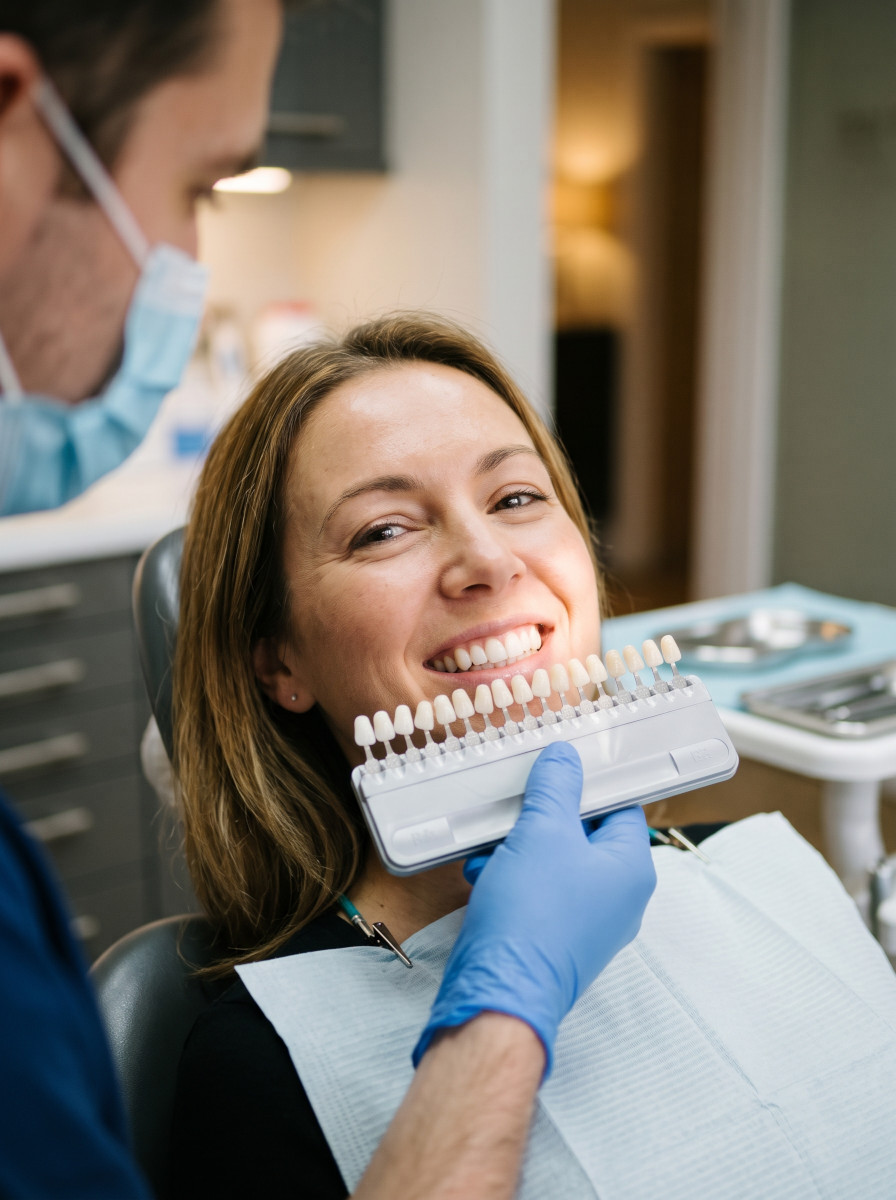


This guide explains how we plan smile makeovers at Oriel Villas Dental Surgery in Cheltenham, which treatment fixes which problem, how long the work takes and what it costs.
A plan, not a product
You will not find a smile makeover listed on our fees page, because it is not one treatment. It is a combination chosen for your teeth, drawn from work we already do every week: whitening, composite bonding, porcelain veneers, crowns, Invisalign or fixed braces, and, where teeth are missing, bridges or implants.
Some makeovers are small. Whitening followed by bonding on two chipped edges counts, and it might be finished within six weeks. Others run for more than a year and combine straightening, whitening and several porcelain restorations. The same word covers both. What they share is a single plan, written down before anything starts, so you know the stages, the timeline and the total cost from the first day.
Which treatment fixes which problem
Colour. Teeth that have yellowed or dulled with age, tea or coffee usually respond well to professional whitening. We make custom trays and you wear them at home with prescription gel for around two weeks. Whitening cannot change the colour of fillings, crowns or veneers, which is the whole story behind those two grey crowns.
Small chips, gaps and uneven edges. Composite bonding adds tooth coloured resin directly to the tooth, usually without any drilling, in a single visit. It is the workhorse of most makeovers we plan.
Heavier wear, deep staining or teeth that need reshaping. Porcelain veneers are thin shells made by a dental technician and bonded to the front of the tooth. They take two or three appointments and may need a thin layer of enamel removed, but they resist staining and last far longer than resin.
Heavily filled or root treated teeth. A crown covers the whole tooth, protecting it as well as changing how it looks. When a front tooth is more filling than tooth, a crown is often the sounder choice.
Crooked or crowded teeth. Straightening with Invisalign or fixed braces moves the teeth themselves. Bonding and veneers can disguise mild crookedness, but on genuinely crowded teeth, disguise means removing more enamel to make everything line up. Straightening first often means less cosmetic work afterwards, and occasionally none.
Missing teeth. A gap is filled with an implant, a bridge or a denture. We compare all three in our guide to implants, dentures and bridges.
The order matters more than the menu
Most makeovers follow the same sequence. The logic is worth knowing, because this is where money is either saved or wasted.
- Health first. Decay, gum disease and failing fillings are treated before anything cosmetic. Resin placed next to inflamed gums does not stay looking good for long.
- Move the teeth. If straightening is part of the plan, it comes next. Once teeth sit in a better position, the work needed on top of them often shrinks.
- Set the colour. Whitening comes before any bonding, veneers or crowns, because those are matched to your shade on the day they are made and never change afterwards. We usually allow a couple of weeks after whitening for the colour to settle before matching anything to it.
- Shape and restore. Bonding, veneers and crowns go on last, matched to the new colour and the new positions.
- Protect it. Retainers after straightening, a night guard if you grind, and regular hygiene visits to keep resin polished and gums healthy.
How we plan a makeover at Oriel Villas
New patients begin with our new patient examination, which includes X-rays, a treatment plan and a quotation. Existing patients can raise it at a routine visit. Either way, the first conversation is about what bothers you when you look in the mirror, which is not always the thing a dentist would point to first.
We then take photographs and digital scans so we can study the smile from every angle, including side on, a view most patients never see of themselves. For bonding and veneer cases we can often make a mock up: temporary material placed over your own teeth so you can see the proposed shapes in your own mouth and your own face before anything permanent happens. It is the quickest way to settle questions like how long the front teeth should be, or whether you prefer softer, rounder edges to squarer ones.
You leave with a written plan setting out each stage, the order, the likely number of appointments and the fee for each step. Nothing begins until you have read it and are comfortable with it.
How long does a smile makeover take?
Whitening followed by bonding usually takes about a month to six weeks from start to finish, most of it the whitening and the settling period afterwards. Whitening followed by veneers is typically six to eight weeks, allowing time for the laboratory. Where straightening comes first, add anywhere from a few months to around eighteen, depending on the orthodontic treatment, with the cosmetic stages after that.
If you are working towards a date, a wedding or a significant birthday, tell us at the start. We plan backwards from it, and if it is too close for the plan you have in mind, we will say so and suggest what can realistically be done in the time.
Keeping the result
Composite bonding typically lasts five to seven years and benefits from a polish at hygiene visits. Porcelain veneers and crowns often last ten to fifteen years, sometimes much longer. Whitening fades slowly and can be topped up using the trays you already have. If you grind your teeth, a night guard protects new work; ours range from a soft acrylic guard to a Michigan splint, and we will recommend the one that suits your bite. Regular hygiene appointments keep the gums healthy, and healthy gums frame everything else.
Frequently asked questions
Will my teeth look fake?
Can I have a smile makeover on the NHS?
Does any of it hurt?
Can I do it in stages?
What if I only want one tooth fixed?
Talk it through with us
Bring a photograph of a smile you like, your own from years ago or anyone else’s, along with a list of what bothers you now. We will look, listen and tell you what is realistic and what it would cost. Call Oriel Villas Dental Surgery in Cheltenham on 01242 523531, use our private line 07741 593675, or email practice@orielvillasdental.com.
Written by Dr Magdalena Wojcicka,
Dentist at Oriel Villas Dental Surgery
(GDC No. 84983)